There is an ancient festival for the particular agony of loving a mortal thing at the incandescent height of its beauty, precisely when the dark has begun to quicken inside it. And like so much of the ancient work of tending bodies toward and away from this world, this knowledge belonged to women.
The Adonia was an unofficial festival of ancient Greece, celebrated largely among women, on rooftops, in houses, in the fugitive territories of female life. No solemn procession of important men was required. Its god was Adonis, the exquisitely beautiful mortal beloved of Aphrodite, killed young and mourned extravagantly. Its central horticultural mystery was almost perversely simple: the women planted gardens designed to die. They sowed seeds in shallow vessels with too little earth to sustain them, then drank, sang, mourned, and coaxed them into quick, green life. Within eight days the plants sprang upward with all the obscene confidence of viriditas and, having nowhere for their roots to go, began almost immediately to wither. At the end of the festival, the women gathered up the spent gardens and carried them away to be ritually cast into the sea or into springs.
These were called the Gardens of Adonis: brief, feverish little gardens where desire and disappearance were made to grow from the same handful of earth. What kind of people sow a garden knowing they will have to mourn it, you ask so innocently? People who know something about love.
I have been thinking about the Adonia nonstop in this voluptuous extremity of Late Summer, when the hills have gone leonine beneath the sun and every garden seems to be spending itself toward some magnificent conclusion. Figs split their purple skins from the pressure of their own sweetness, fallen fruit ferments into nectar for wasps and flies, even the afternoon light has thickened into something amber and narcotic. August has the temperament of a Greek god at the end of a feast: gilded, drunken, profligate, already carrying the underworld in its mouth.
Late Summer has never struck me as a season of simple abundance. It is abundance beginning to reveal its terrible secret, the one it hides deep inside of coffers of nectar and incandescent fuzz: Everything ripens toward disappearance.
And this summer I am learning this terrible botany in the body of my father, for he, too, is withering. There is no prettier word for it, nor one I trust more. Since the grand undoing of April, the vigorous architecture by which he once moved through the world has been relinquishing itself by increments: muscle loosening its claim on bone, appetite retreating, swallowing becoming labor, his eyes increasingly closed to us, and speech—which once seemed so ordinary I could telephone him without reverence—becoming rare enough to feel like visitation. One by one the old vestments of personhood have fallen away: his apartment, his clothes, his independence, his ability to walk, bathe and feed himself; in their place came the feeding tube, the diaper, the hospital bed, three pneumonias, and the strange medical liturgy of paperwork, Medi-Cal applications, and DNRs. The man who once occupied the world with such specificity is still here, emphatically and irreducibly my father, but the body that has carried him for nearly ninety years has begun loosening its ancient agreements with life.
I find myself studying every small sign for evidence that some hidden root still holds—how is his breathing, did he recognize anyone, can he lift the telephone, can he swallow?—as though sufficiently exquisite attention might reveal the occult mechanism by which a beloved body can be persuaded to remain. I keep wanting the garden to have deeper soil, more water, another season. Perhaps this is one of the great cruelties of caretaking: love disguises mortality as a problem that greater devotion ought to be able to solve. As a taoist physician, I am particularly susceptible to this delusion; I have spent my adult life studying the mysterious technologies by which the failing organism may be fed, warmed, moved, fortified, coaxed back toward itself, and somewhere in me persists the ancient and impossible conviction that if I can only find the right medicine, the right nourishment, the deeper layer of earth, I might persuade his roots to hold.
Love becomes frantic housekeeping at the threshold of the underworld, and women have been keeping this vigil for as long as bodies have been entering and leaving the world. We have learned by hand the humiliations and sacraments of incarnation. We have washed the sheets beneath the dying, held bowls beneath mouths, wiped shit from bodies that once carried us, pressed cool cloths to foreheads, made soup no one wanted, listened from the next room for the cough and learned, eventually, the terrible significance of silence. There is an entire female history of civilization written in basins of dirty water, an unrecorded liturgy of tending performed at bedsides and birth beds, wherever the grand abstractions of life and death collapse into the animal facts of blood, milk, shit, sputum, hunger, fever and breath. And every caretaker eventually arrives at the humiliating limit of her devotion: the place where no greater tenderness, competence or vigilance can bargain another season from the body, and love must relinquish its fantasy of rescue without relinquishing the beloved.
.jpg)
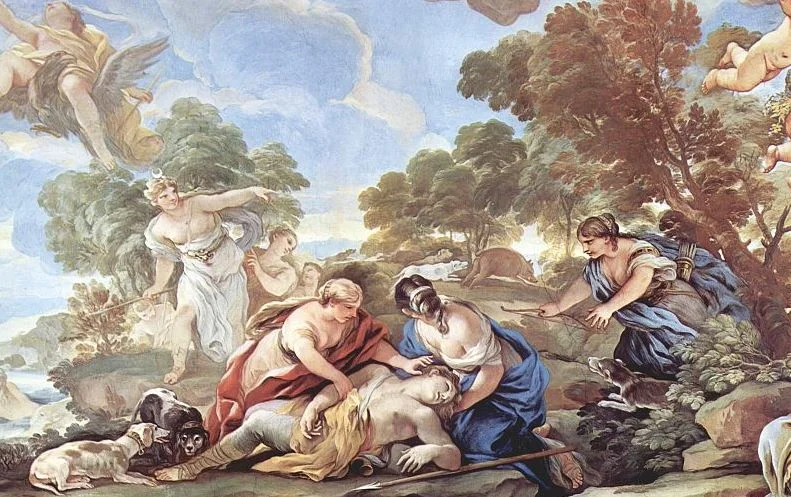
The women of the Adonia understood something about this that our culture, with its heroic medicine, anti aging industries, refrigerated flowers and embalmed bodies, does not particularly wish to know. They did not plant an everlasting garden but a mortal one, a little green cosmos whose beauty depended upon its brevity. And when its tender shoots leapt astonishingly toward the sun and then bowed back toward the earth, the women did not intervene in the old traffic between flowering and disappearance. They remained beside the garden and wailed. We can learn a few things from their ecstatic grief.
Outside my life as a doctor, I was once a priestess in a community devoted to the ritual mysteries of sex and death, where I learned that grief, given a body and witnesses, can become a form of gnosis. This is not a metaphor. The most potent rites I encountered asked us not to master sorrow but to enter it bodily, to wail and writhe and weep in the company of others until the civilized membrane between self and world grew thin enough to become permeable. I remember bodies collapsed together on the floor in mourning and the almost unbearable aliveness that came when every small fiction of permanence had been stripped away. Grief has this strange erotic intelligence: it returns us, naked of reassurance, to the terrible intimacy of being temporary creatures among other temporary creatures.
Perhaps this is why the myth of Adonis feels to me less like tragedy than a vegetal transmission on the erotics of impermanence. He enters the world already entangled in the promiscuous metabolism of the living: his mother Myrrha becomes a myrrh tree, the tree splits open, and from its fragrant wound emerges an exquisitely beautiful mortal boy. Then Eros gets its hands on him. Aphrodite adores him, a wild boar opens his thigh, his hot blood enters the earth, and the grieving goddess pours nectar into the wound until anemones push their tender heads through the soil. Woman becomes tree becomes boy becomes lover becomes blood becomes flower, the ten thousand things eating, fucking, flowering, dying, forever slipping their little identities into one another. Adonis is Tao briefly persuaded into the unbearably beautiful shape of a man, and the myth offers no clean border between incarnation and decomposition, only form surrendering itself promiscuously into form.
The women of the Adonia understood that such knowledge cannot remain philosophical for very long; eventually the animal body must be given somewhere to put it. Our culture prefers grief rehabilitated into composure, something to be processed, moved through, brought to closure and returned neatly to the private sphere, as though sorrow were an administrative backlog and successful mourning meant becoming socially unobjectionable again. The women had another idea: take it to the roof! Bring wine, bring lettuce, bring your girlfriends, bring the dead beautiful boy and the goddess who could not save him, and make of the rooftop a temporary autonomous zone of lamentation above the ordered city, where grief could be planted, danced beside, screamed through the body and returned to its ancient status as evidence that something had been extravagantly adored. Their gardens did not ask sorrow to become useful: they gave it soil and witnesses.
This would already be enough of a teaching for one summer. But Aphrodite, apparently, has a vicious sense of timing.
At precisely the moment I am being initiated into the unbearable fact of losing someone I have loved for my entire life, I have fallen in love. New love has entered the same house as anticipatory grief, and suddenly the Adonia is no longer an ancient ritual I am contemplating but a cosmology taking place inside my own animal body. I can no longer pretend that I love you contains anywhere within it the promise I get to keep you. There is no version of the story in which nobody loses anybody. This is the obscene clause buried in every love contract. Aphrodite signs it. So do we.
We have sentimentalized Aphrodite because we prefer our goddess of love without her funerary knowledge, giving her roses while politely removing the vase before the petals brown. But Aphrodite is older and wetter than romance. Born from sea foam, she governs the great promiscuous appetite by which life reaches wildly beyond itself: mycelium trafficking sugars beneath the forest floor, pollen fastening itself to fur and wing, bodies exchanging breath, saliva, heat and microbial worlds in the dark. But Aphrodite’s dominion is not merely the promiscuous abundance of attraction; it is also the terrible particularity of attachment. The goddess who draws the living world toward itself does not love Adonis as an emblem of mortal beauty, or as one fleeting configuration of the eternal Tao. She loves Adonis. This body, this smell, this mouth, this particular ridiculous mortal among the ten thousand things. This is what love does to the great metaphysics of impermanence: it points into the teeming multitude and says, yes, yes, everything changes—but not this one! Let me keep this one.
If you worship beauty long enough, you become a student of decay; if you worship love long enough, you become a student of grief. Aphrodite can adore Adonis, mourn him, pour nectar over what remains of him, but even a goddess cannot compel the particular form she loves to remain. And this is where all our beautiful philosophies of transformation become difficult to bear, because grief revolts against metaphor precisely when metaphor threatens to carry the beloved away. I do not want some abstract cosmic father dissolved serenely into the ten thousand things; I want mine. I want the particular arrangement of matter that made him himself. And there is now another particular form I find myself petitioning the cosmos not to tamper with: my lover, another gorgeous mortal damned like the rest of us. He is a daring man who builds worlds with his hands, who seems to regard the impossible as merely a problem of imagination and materials, and whose courage has the unnerving effect of making life itself feel more possible in his presence. Tao may be promiscuous with form, forever making one body from the relinquishment of another, but love is scandalously particular. We fall in love with the temporary shape of things while the cosmos is already unfastening their buttons.
Chinese medicine locates Late Summer precisely inside this erotic contradiction, when yang has spent itself into such voluptuous excess that its opposite begins stirring within it. Yin is conceived inside the swollen fruit, the lengthening shadow, the damp congealing into pearls. The garden is still riotous aboveground while already secreting its future into seed and root. Everything is still here, yet everything is already leaving. Generation and dissolution are not adversaries in this cosmology but movements within one continuous transformation, each secretly gestating inside the other. The old Chinese physicians understood what the women on the rooftops understood: the withering is not what happens when the garden fails. The withering belongs to the garden.
And so the Gardens of Adonis begin to look to me like a little Taoist cosmology in broken pottery: the green shoot and the brown, withering stem are not opposing events but one continuous gesture of becoming. The women adore the garden at the incandescent seam where ripeness and ruin become almost impossible to tell apart, and I find myself there with them now, stretched between my father’s dying and the almost obscene vitality of new love, one hand tending what is leaving while the other reaches greedily toward what has just arrived. They seem to belong to opposite mysteries, but the season knows better. Impermanence does not make the mortal world less worthy of attachment; it makes our brief possession of one another unbearably precious.
I want to revive the Adonia, not as some expensive neopagan workshop with linen dresses and hand-thrown amphorae in an Ojai garden. I want it feral. I want the roof! I want every woman who has ever kept vigil beside something she could not save: the daughter spooning food into her mother’s mouth, the woman watching IVF fail, a forest burn, her own body become strange to her. Bring your dead and your almost-dead! Bring the house that burned, the creek that dried up, the breast you lost, the lover you left, the lover you have just met and are already terrified to lose. Bring everything you were foolish enough to adore.
We will plant lettuce in broken pots, fennel in chipped bowls, barley in old coffee cans, too densely and in too little earth, and carry the whole green trembling mess onto the roof where, for once, we will resist the modern compulsion to save everything. We will not optimize the garden or rehabilitate our grief; we will not turn loss into a lesson or interrogate the dying thing about what it has come here to teach us. We will drink wine, make a racket, and tend what is tender while the stems reach stupidly and magnificently toward the sun. And when they begin to wither, we will remain beside them in the strange genius of the Gardens of Adonis, where the gods make no promise that devotion can prevent disappearance. They have only given us somewhere to put our love.
Perhaps this is the erotics of impermanence: mortality makes us exquisitely susceptible to the world, each temporary form acquiring the terrible radiance of something that can happen only once. The ten thousand things blaze briefly into particularity—Adonis warm beneath the hands of Aphrodite, my father still lifting the telephone to his ear when I call despite not being able to speak, Jonathan bustling in his garden, building me a ceramic temple to Venus—and for a little while the great promiscuous Tao gathers itself into these astonishing and unrepeatable arrangements of matter. Here is the Late Summer garden trembling at the threshold of its undoing; here are the mortal forms we recognize among the teeming multitude and, impossibly, come to adore. What else can we do with such terrible beauty but fall to our knees? Let the women howl on the rooftops. Let Aphrodite kneel in the dirt. Let the garden flower extravagantly into its own disappearance. And when the mortal thing comes incandescently into your hands, love it past reason, past wisdom, past every spiritual ambition to transcend the temporary world. Dare yourself not to look away.


%401x.svg)